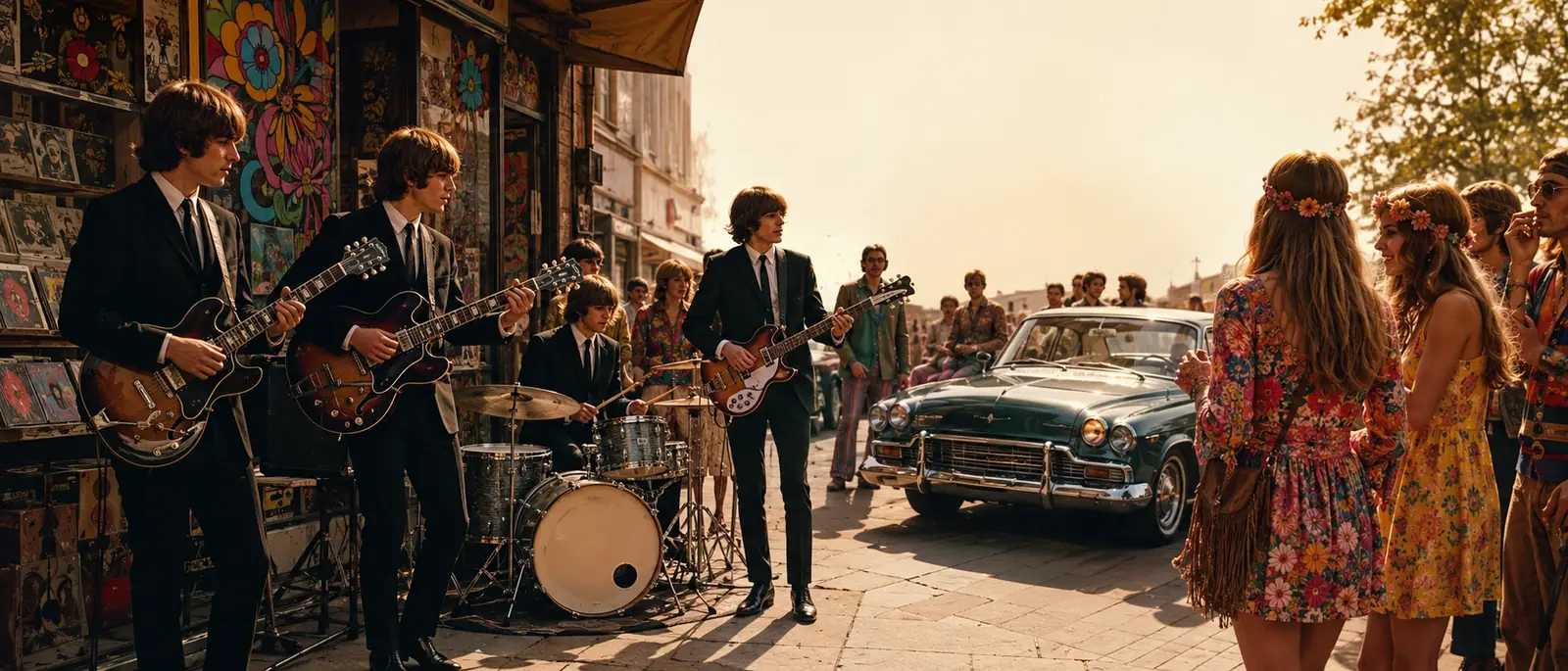
The 1960s were defined by musical expansion. Beat music, Motown, Southern soul, girl-group pop, surf, folk rock, psychedelia, garage rock, blues rock, early progressive music and international pop all grew rapidly and often overlapped.
British Invasion and beat music
Liverpool and London produced different versions of the new British sound. Merseybeat emphasized harmony and concise pop songwriting, while British blues groups built a tougher style from American R&B and Chicago blues.
Motown and soul
Motown created a polished Detroit hit-making system, while Memphis, Muscle Shoals and other Southern scenes developed a grittier soul language. James Brown pushed rhythm toward funk, changing the role of the beat itself.
Folk, protest and folk rock
Bob Dylan, Joan Baez and the folk revival brought political songwriting into youth culture. When electric guitars entered the scene, folk rock became one of the decade’s most influential hybrids.
Psychedelia and studio experimentation
The Beatles, The Beach Boys, Pink Floyd, Jimi Hendrix and others used the studio as a creative instrument. Tape effects, orchestration, unusual instruments and long-form arrangements expanded the sonic possibilities of pop and rock.
Surf, garage, blues rock and hard rock
Surf music brought instrumental guitar and California imagery to the mainstream, while garage bands favored raw simplicity. Blues rock and heavier guitar groups then laid the groundwork for hard rock and metal.
Beyond Britain and America
Yé-yé, chanson, Italian pop, bossa nova, Tropicália, ska and rocksteady made the decade globally diverse. The 1960s were already an international pop system.
Explore style pages: British Invasion & Merseybeat · Motown · Southern Soul · The Birth of Funk · Folk Revival · Folk Rock · Psychedelic Rock · Garage Rock · Blues Rock · Hard Rock & Proto-metal · Bossa Nova, MPB & Tropicália · Ska, Rocksteady & Early Reggae.