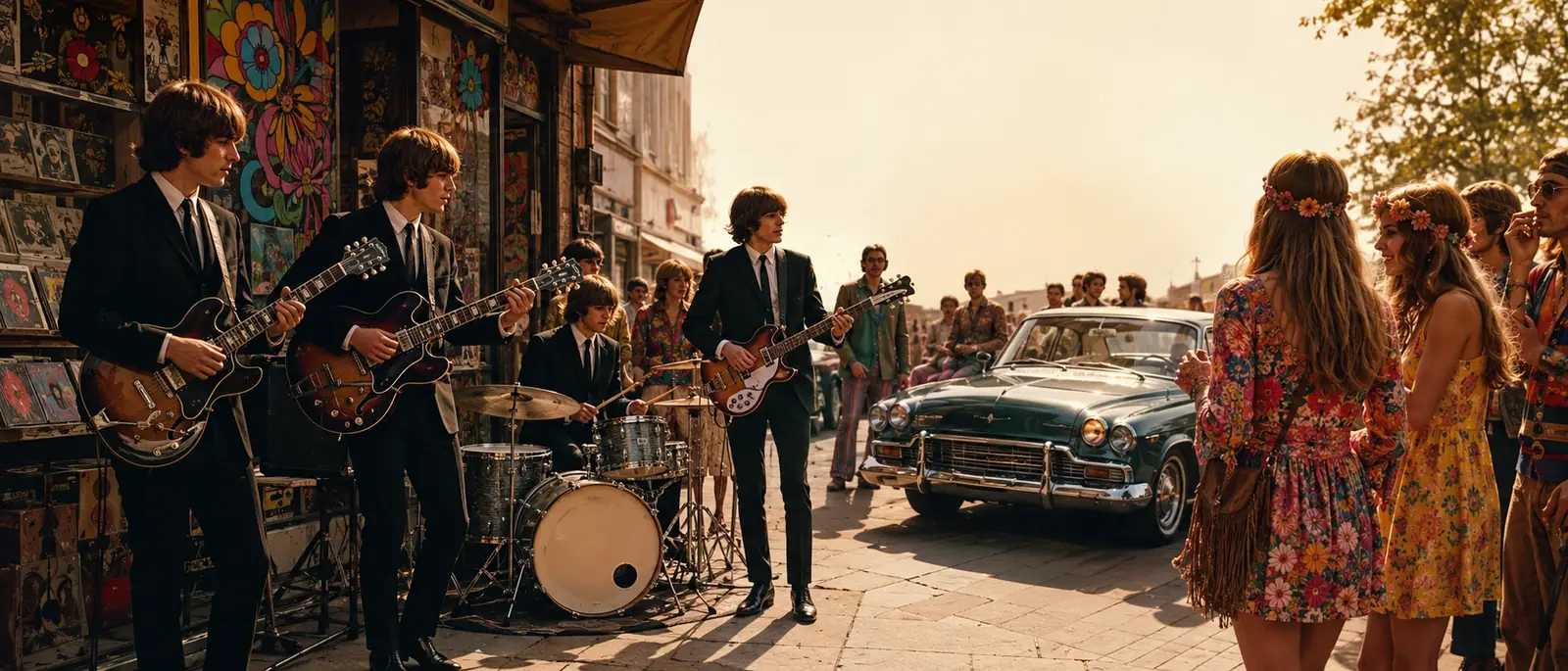
1960–1969 · Oldies Radyo Decade Archive
The 1960s were not simply a decade when popular music changed. They were a decade when popular music began changing the culture around it. British Invasion, Motown, Southern soul, folk protest, surf music, girl-group pop, psychedelia, funk and early reggae all developed in conversation with one another across countries and scenes.
The decade is often reduced to The Beatles and the counterculture, but the full story is much larger. Elvis Presley, Frank Sinatra, Ray Charles and Johnny Cash remained important; Motown turned Detroit into a global pop center; Memphis and Muscle Shoals gave soul a different emotional weight; France, Italy, Brazil and Jamaica built equally distinctive musical identities.
From the first rock ’n’ roll generation to a new pop system
At the beginning of the decade, the energy of 1950s rock ’n’ roll had not disappeared. It had spread into new forms. Brill Building songwriters, girl groups, dance crazes, surf guitars and polished pop dominated the early years while British musicians studied American blues, R&B and rock ’n’ roll intensely.
Then came the 1963–1964 break. The Beatles and the wider British Invasion did more than create a new fashion in bands. They helped move songwriting, albums, group identity and studio experimentation toward the center of youth culture. At the same time, Motown proved Black artists could achieve sustained mainstream pop success on a massive scale.
Three main routes through the archive
- Year by year: follow the decade from 1960 to 1969, including the British breakthrough, civil-rights-era soul, folk protest, psychedelia and the rise of album culture.
- Artists: explore The Beatles, The Rolling Stones, The Who, The Kinks, The Beach Boys, Bob Dylan, The Doors, Jimi Hendrix, The Supremes, Marvin Gaye, Aretha Franklin and many more.
- Styles and scenes: move through British Invasion, Merseybeat, Motown, Southern soul, folk rock, garage rock, psychedelic rock, blue-eyed soul, bossa nova, ska and early reggae.
Britain, America and the wider world
Britain’s story runs from Liverpool’s beat groups and London’s blues clubs to Mod culture, psychedelia and progressive rock. In the United States, Detroit’s hit-making system, Southern soul, New York folk, California pop and San Francisco counterculture all produced different answers to the same rapidly changing decade.
Outside the English-language mainstream, France developed yé-yé and modern chanson; Italy moved from Sanremo pop toward a stronger singer-songwriter tradition; Brazil gave the world bossa nova, MPB and Tropicália; Jamaica moved through ska and rocksteady toward reggae. The 1960s were already a global pop conversation.
Music becomes part of public life
Civil rights, Vietnam, generational conflict and the counterculture changed the meaning of popular music. Sam Cooke, Nina Simone, Bob Dylan, Joan Baez, James Brown and others showed different ways a song could carry social memory, identity or protest.
Politics was not only in lyrics. Long hair, fashion, album covers, television appearances, festivals and the very idea of a youth market became part of the argument about how society was changing.
The studio becomes an instrument
By the middle of the decade, the LP was becoming more than a collection of singles. The Beatles, The Beach Boys, Bob Dylan, The Rolling Stones, Jimi Hendrix and others used multitrack recording, tape manipulation, unusual instruments and increasingly ambitious arrangements to create music that could not simply be reproduced onstage.
That shift changed how listeners approached records. Albums could now be cultural events, complete artistic statements and objects to study rather than just containers for hits.
Continue to the 1970s
The next decade would split the 1960s revolution into many competing systems: hard rock, progressive rock, glam, funk, disco, singer-songwriters, reggae, punk and electronic music.