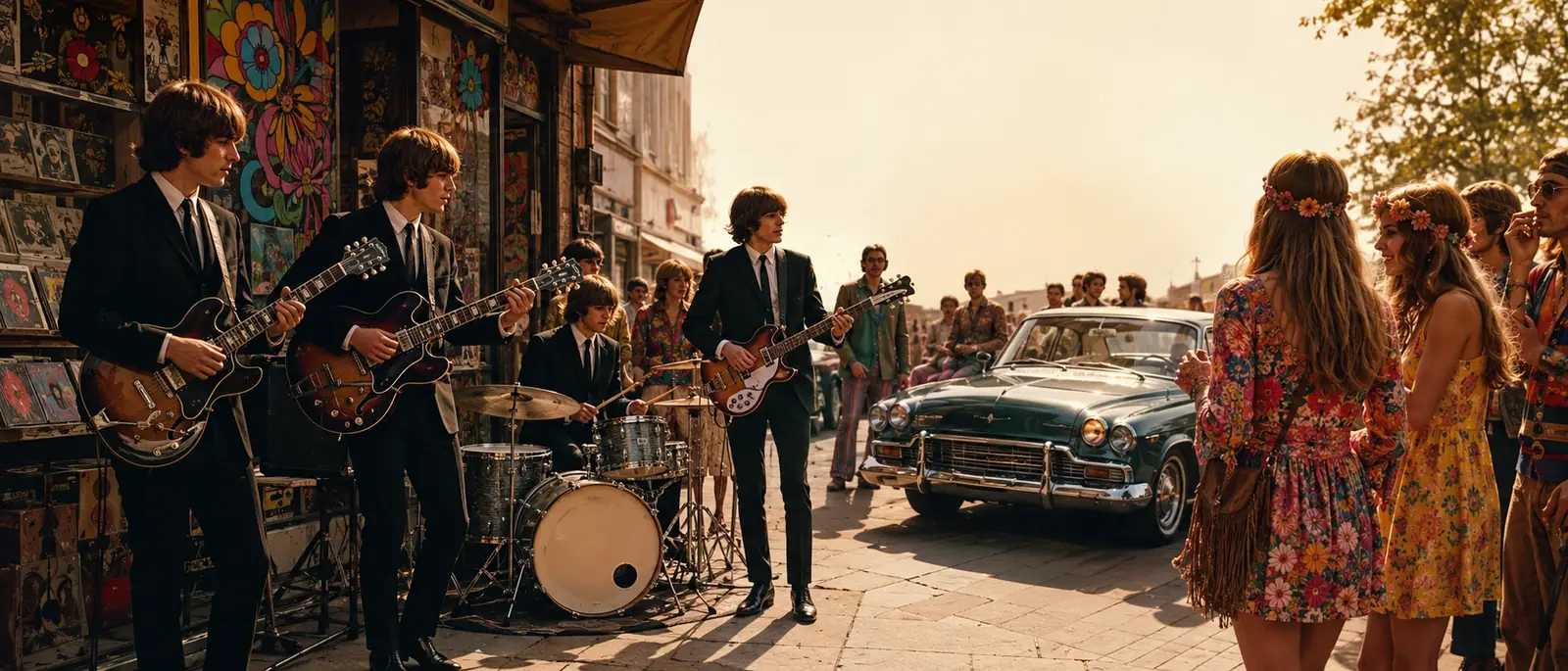
1960–1969 · A decade of accelerating change
The 1960s began with the first rock ’n’ roll generation already changing shape. By the end of the decade, British Invasion, Motown, soul, folk rock, psychedelia, funk, hard rock and early progressive music had transformed the idea of what popular music could be.
1960–1962: transition, teen pop and soul foundations
Elvis returned from the Army, Brill Building pop flourished, girl groups rose and Motown began building a new Detroit sound. Ray Charles, Sam Cooke, The Shirelles and early surf music all pointed toward different futures.
1963–1964: the British breakthrough
The Beatles exploded in Britain and then the United States, opening the door for The Rolling Stones, The Animals, The Kinks and many others. At the same time, Motown and Southern soul were becoming major national forces.
1965–1966: pop becomes more ambitious
Folk rock, protest songs, studio experimentation and increasingly sophisticated albums changed the center of youth music. Dylan went electric, The Beatles moved beyond beat-group pop and The Beach Boys pushed studio composition forward.
1967: psychedelia and the album era
The Summer of Love, Sgt. Pepper, Hendrix, Jefferson Airplane and the growth of San Francisco culture made psychedelia one of the decade’s defining images. Albums increasingly became complete artistic statements.
1968–1969: harder sounds, political tension and new directions
Hard rock, blues rock, early progressive music and funk grew stronger as the optimism of the mid-1960s became more complicated. Woodstock symbolized one side of the counterculture, while political unrest and social conflict reshaped another.
How to use this timeline
Each year in the Oldies Radyo archive has its own detailed page. Read chronologically or jump to the moment that matters most to you.
Explore each year: 1960 · 1961 · 1962 · 1963 · 1964 · 1965 · 1966 · 1967 · 1968 · 1969.