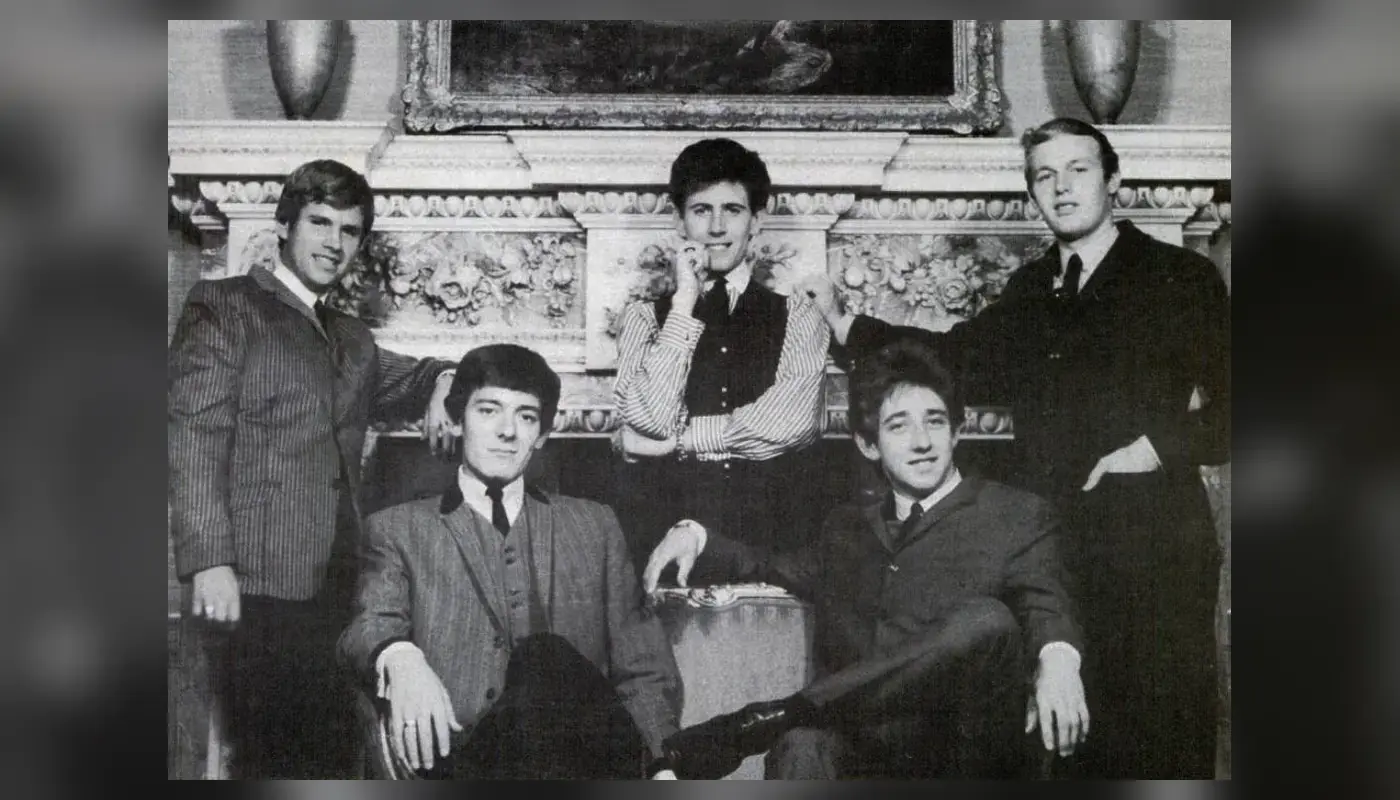
The Hollies
Beat / Harmony Pop / Folk Rock
The Hollies, from Manchester, became one of the most consistent British pop groups of the 1960s through bright three-part harmonies and a strong repertoire of singles.

The story through the 1960s
The Hollies, from Manchester, became one of the most consistent British pop groups of the 1960s through bright three-part harmonies and a strong repertoire of singles.
Manchester and the vocal partnership
Allan Clarke and Graham Nash’s childhood friendship formed the foundation. Tony Hicks’s guitar and harmony contribution completed the distinctive three-part vocal sound. Emerging from Manchester clubs, the band began recording for Parlophone in 1963.
They initially interpreted American R&B and pop repertoire. “Stay”, “Just One Look” and “Here I Go Again” soon established them as a strong singles act.
Hit records and original songwriting
The Clarke–Hicks–Nash partnership expanded the original material. “We’re Through”, “Stop Stop Stop”, “On a Carousel” and “Carrie Anne” defined the sound through rhythmic guitars, clear melodies and high harmonies.
Their particular achievement was a remarkable continuity of quality within the decade’s singles culture. Accurate vocals and assured live playing also made them dependable performers across long tours.
Psychedelia and Graham Nash’s departure
Butterfly and Evolution approached the period’s psychedelic colours with more detailed arrangements. Nash wanted a more experimental, personal direction; the others were more inclined to retain the hit-making approach.
Nash left in 1968 to form Crosby, Stills & Nash with David Crosby and Stephen Stills. The Hollies recruited Terry Sylvester and continued, moving towards larger ballads such as “He Ain’t Heavy, He’s My Brother”.
Sound and stage identity
The strength lay in close harmonies surrounding the main melody. Hicks added variety through banjo, guitar and arrangement. Bobby Elliott’s energetic drums gave the apparently light recordings a firm rhythmic foundation.
The influence beyond the songs
The Hollies represented another side of the British Invasion alongside its tough blues bands. Their influence on harmony pop, folk rock and melodic guitar pop reached into 1970s soft rock and jangle pop.
Vocal architecture and hit records
The bright harmonies of Clarke, Nash and Hicks were the defining feature. The band drew on Buddy Holly and the Everly Brothers, then developed a cleaner, layered British pop language at EMI’s Abbey Road studios. Elliott’s agile drumming and Hicks’s guitar gave substance to the vocal-centred arrangements.
“Bus Stop”, “On a Carousel” and “Carrie Anne” combined strong melodies with rhythmic details and different instrumental colours. Their image was less radical than those of the Beatles or Stones. Sustained singles success and professional stage discipline nevertheless represented a durable model of British Invasion pop.
Graham Nash’s departure and a changing era
Nash’s desire for more experimental and personal songs met a cautious management and colleagues concerned with maintaining the audience. Decisions including a proposed album of Dylan songs increased his creative restlessness and helped prepare his 1968 departure to join Crosby and Stills.
Sylvester’s arrival rebuilt the harmonies after Nash left. More emotionally expansive records such as “He Ain’t Heavy, He’s My Brother” introduced a new phase. The transition showed how a band could reconfigure its identity at the decade’s end after losing a founding member.
Selected recordings for exploring the decade
This chronological selection follows the career’s direction, changes in sound and major turning points across the decade. It is a listening route rather than a ranking of the best songs. Individual recording features will be linked as they become available.
Stay
American R&B given bright British vocal energy.
Just One Look
A Doris Troy song transformed into a harmony-pop classic.
Look Through Any Window
A strong balance of rhythm, melody and three-part singing.
Bus Stop
Major international success with a Graham Gouldman composition.
Stop Stop Stop
A distinctive pop experiment built around a banjo riff and a story.
Carrie Anne
Elegant harmonies and steel-drum colour in a period classic.
He Ain’t Heavy, He’s My Brother
The move towards larger, emotionally weightier ballads.
Explore original Oldies Radyo designs
All the T-shirt, mug and wallpaper previews shown here come from Oldies Radyo’s Etsy listings.

1964 British Invasion Wallpaper
An original Oldies Radyo design bringing the London beat scene, young guitar bands and the energy of 1964 into the music room.
View on Etsy →
1968 Peace, Love & Groovy Wallpaper
An original Oldies Radyo design inspired by 1968, with flowers, peace signs, guitars and the period’s spirit of freedom.
View on Etsy →
Mods vs Rockers T-shirt
An original Oldies Radyo design recalling the famous 1960s rivalry between scooter and motorcycle youth cultures.
View on Etsy →These articles were originally written in Turkish for Oldies Radyo through comparisons of international institutional sources and archives. This English edition preserves their scope and editorial approach.
Related 1960s artist features