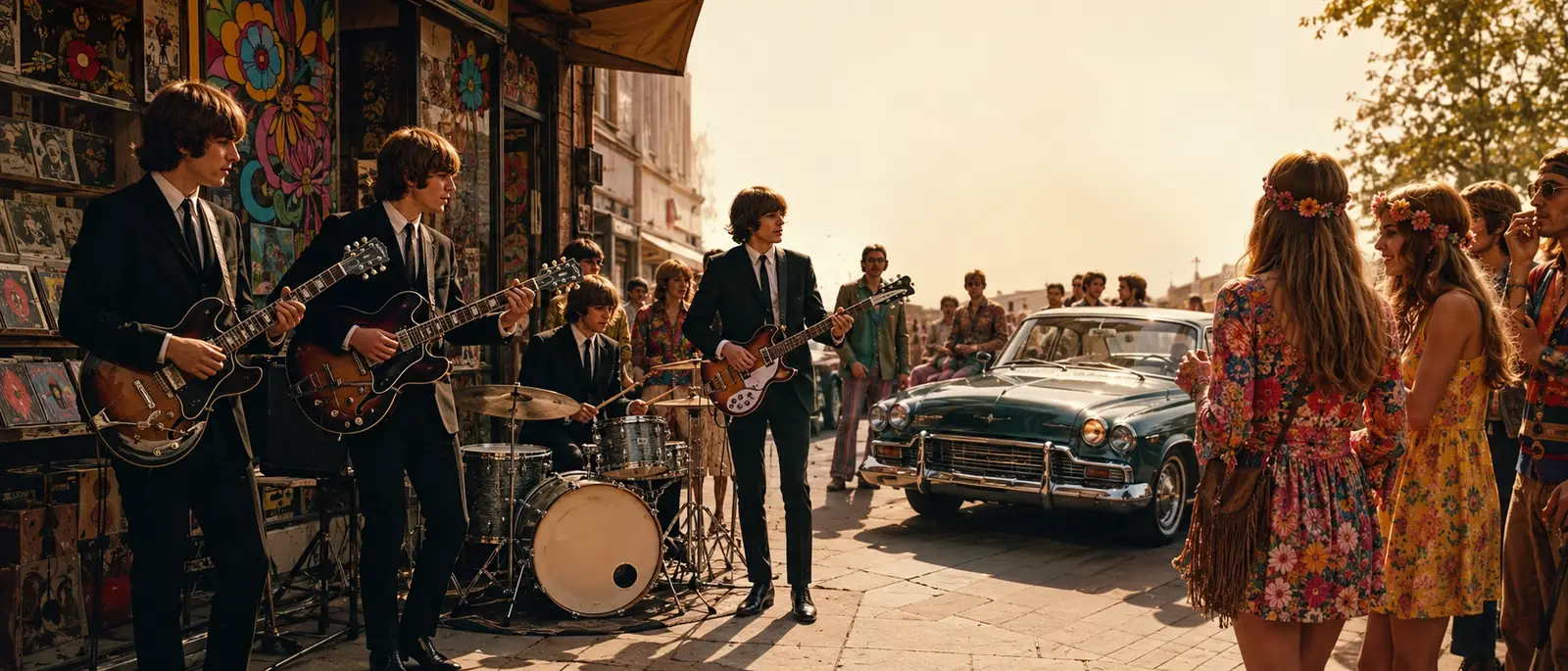
The Beach Boys
Surf Pop / Vocal Harmony / Studio Pop
The Beach Boys travelled from images of California youth into Brian Wilson’s complex studio world, undergoing one of American pop’s great transformations in the 1960s.

The story through the 1960s
The Beach Boys travelled from images of California youth into Brian Wilson’s complex studio world, undergoing one of American pop’s great transformations in the 1960s.
From family harmonies to surf culture
Brothers Brian, Dennis and Carl Wilson formed the band in Hawthorne, California, with cousin Mike Love and friend Al Jardine. “Surfin’” and “Surfin’ Safari” combined emerging surf-youth culture with Chuck Berry-influenced guitar and Four Freshmen-style harmonies.
Dennis was the only member who actually surfed. The images of cars, beaches, school and youthful freedom nevertheless became a national dream. Murry Wilson’s authoritarian management and family pressures created serious tensions alongside the success.
Brian Wilson’s studio vision
From late 1964, Brian withdrew from heavy touring to concentrate on recording and composition. Inspired by Phil Spector’s layered production, he developed more intricate chords, unusual instruments and complex vocal arrangements.
Today! and Summer Days (And Summer Nights!!) revealed growing emotional vulnerability beneath youthful pop. “California Girls” represented the great pop sheen; “Let Him Run Wild” revealed Brian’s inward-looking songwriting.
Pet Sounds and Good Vibrations
Pet Sounds expanded the album’s possibilities through studio musicians, bicycle bells, animal sounds, theremin-like tones and dense harmonies. “Wouldn’t It Be Nice”, “God Only Knows” and “I Just Wasn’t Made for These Times” described the passage from youth into adult anxiety.
“Good Vibrations” became an emblem of modular pop production: sections recorded in different studios were joined on tape. Its cost and long production showed Brian using the studio as an independent instrument of composition.
The SMiLE crisis and different directions within the band
SMiLE remained unfinished amid high expectations, psychological pressure, drug use and doubts within the band. Brian grew more vulnerable. Love argued for more accessible song structures, while the abstract lyrics written with Van Dyke Parks caused disagreement.
Smiley Smile, Wild Honey and Friends turned towards simpler, domestic, group-centred recordings. Carl’s leadership grew. Commercial difficulties towards the decade’s end did not bring the musical exploration to a halt.
The influence beyond the songs
The harmonies established one of pop’s most influential vocal languages. Brian’s production reached from the Beatles to chamber-pop and indie musicians. Within one catalogue, the band carried both the bright exterior and fragile inner life of the American dream.
The SMiLE crisis, the band’s balance and the later years
The months of modular recording for “Good Vibrations” produced a major success. The following SMiLE project remained incomplete under mounting costs, label pressure, internal doubts and Brian’s mental-health difficulties. Its collapse revealed the creative cost of apparently unlimited studio freedom.
After 1967, Carl took greater responsibility for production and performance, while Dennis developed as a songwriter. Smiley Smile, Wild Honey and Friends offered a simpler, homemade, soul-influenced direction. Changing contributions from its members sustained a complex family group with a musical identity extending beyond Brian’s individual genius.
Selected recordings for exploring the decade
This chronological selection follows the career’s direction, changes in sound and major turning points across the decade. It is a listening route rather than a ranking of the best songs. Individual recording features will be linked as they become available.
Surfin’ Safari
An early hit carrying the surf image into the national pop market.
Surfin’ U.S.A.
Chuck Berry-based guitar and a vivid sense of youthful excitement.
I Get Around
A major achievement in harmony, rhythm and precision in the studio.
California Girls
An orchestral pop opening that enlarged the California myth.
Wouldn’t It Be Nice
The opening of Pet Sounds’s passage towards adulthood.
God Only Knows
The love-song form expanded harmonically and emotionally.
Good Vibrations
A studio-pop masterpiece made through modular recording.
Do It Again
A powerful, nostalgic return to the surfing past.
Explore original Oldies Radyo designs
All the T-shirt, mug and wallpaper previews shown here come from Oldies Radyo’s Etsy listings.

1964 British Invasion Wallpaper
An original Oldies Radyo design bringing the London beat scene, young guitar bands and the energy of 1964 into the music room.
View on Etsy →
1968 Peace, Love & Groovy Wallpaper
An original Oldies Radyo design inspired by 1968, with flowers, peace signs, guitars and the period’s spirit of freedom.
View on Etsy →
Mods vs Rockers T-shirt
An original Oldies Radyo design recalling the famous 1960s rivalry between scooter and motorcycle youth cultures.
View on Etsy →- Rock & Roll Hall of Fame — The Beach Boys
- The Beach Boys — Official
- Encyclopaedia Britannica — The Beach Boys
These articles were originally written in Turkish for Oldies Radyo through comparisons of international institutional sources and archives. This English edition preserves their scope and editorial approach.
Related 1960s artist features