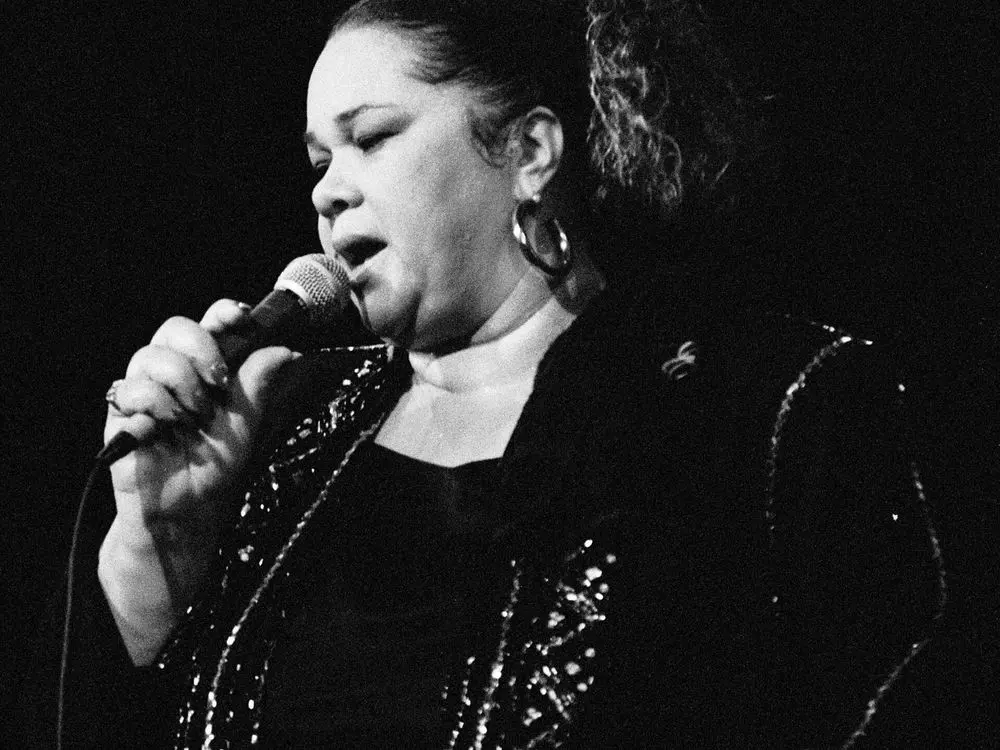
Etta James
Blues / R&B

Still in her teens, Etta James attracted attention with a powerful, raw voice that moved between blues, R&B and doo-wop.
Her 1955 recording “The Wallflower” became a landmark in the era’s answer-song culture. These early sides already carried the emotional intensity that would define her later soul and blues career.
Where did the sound come from?
Jamesetta Hawkins grew up in Los Angeles, where her powerful singing stood out in a church choir. As a teenager, she formed the girl group the Creolettes. Johnny Otis discovered them, renamed the group the Peaches and reversed Jamesetta’s name to give her the stage name Etta James.
Written as an answer to Hank Ballard’s “Work with Me, Annie”, “Roll with Me, Henry” was released in 1955 as “The Wallflower” amid concerns about censorship and radio play. It topped the R&B chart and made James a recognised star at just 17.
The years that changed the course
“Good Rockin’ Daddy”, “W-O-M-A-N” and “Tough Lover” reveal different sides of her 1950s recordings for Modern and Kent. As she moved from group success towards a solo identity, she travelled between blues, doo-wop and rock ’n’ roll, although sustained pop-chart success remained elusive.
The great soul and blues period that began on Chess’s Argo label in 1960 still lay ahead. Yet the 1950s records already possessed the raw energy of the formidable ballad singer she would become, along with a female narrator’s sexual confidence.
What made the sound instantly recognisable?
Her young voice brought gospel-trained power together with the grain of the blues and doo-wop’s group harmonies. She was not interested in a polished surface: she fractured words, added a growl and created tension by moving slightly ahead of or behind the beat.
The answer-song structure of “The Wallflower” gave a female narrator the chance to respond directly to a male-centred hit culture. The independent, wounded character that would grow through James’s later repertoire was already taking shape.
The world behind the stage
Her early career reflects a system in which producers and record companies rapidly shaped young Black female performers. Even so, the individuality of her voice pushed beyond the limits of the material she was given.
Turning points
As a young singer in Los Angeles, James formed the Creolettes and caught Johnny Otis’s attention. Their answer song “Roll with Me, Henry” reached listeners in 1955 under the less contentious title “The Wallflower” and became a major R&B hit. Her Modern Records period continued with “Good Rockin’ Daddy”, “W-O-M-A-N” and a mixture of group and solo recordings. Her 1950s voice was youthful, rough-edged and rooted in R&B; the emotional force of her later orchestral soul and blues work for Chess and Argo was already developing.
Inside the studio
Doo-wop responses, tenor saxophone and a swinging rhythm stand out on the early recordings. Her voice was strikingly deep, grainy and assertive for someone so young. “The Wallflower” used humour to express a female narrator’s sexual and social confidence. Its reply to Hank Ballard’s “Work with Me, Annie” places it firmly within R&B’s answer-song tradition. Johnny Otis’s production gave the young singer’s raw energy an orderly pop-song framework.
Who carried the influence forward?
Although her best-known records date from the 1960s, James’s earlier work shows an active role in the formation of rock ’n’ roll, doo-wop and R&B. Singers from Janis Joplin to Christina Aguilera drew on her powerful chest voice and emotional openness. The changes of genre across her long career reflect the struggle of Black female artists to retain a personal sound while moving between the market’s labels.
A listening guide to the 1950s
This is a listening route, not a ranking of the best songs. These starting points trace the artist’s development across the decade, different sides of the music and its place in history.
The Wallflower (Dance with Me, Henry)
An answer song transformed into a commanding R&B hit.
Good Rockin’ Daddy
A tough vocal over a danceable beat.
W-O-M-A-N
A witty, confident declaration of female identity.
Tough Lover
A fast rhythm and an astonishingly forceful vocal attack.
The legacy in music history
She built a powerful bridge between the R&B of the 1950s and modern soul singing.
Etta James’s musical identity took shape in the 1950s and continued to resonate in later decades through fresh interpretations of the repertoire, echoes of the stage approach and direct influence on other musicians. In this dossier, Oldies Radyo considers the artist as a creative force in the evolution of popular music, alongside the nostalgic appeal.
These articles were originally written in Turkish for Oldies Radyo through comparisons of international institutional sources and archives. This English edition preserves their scope and editorial approach.
Related 1950s artist features