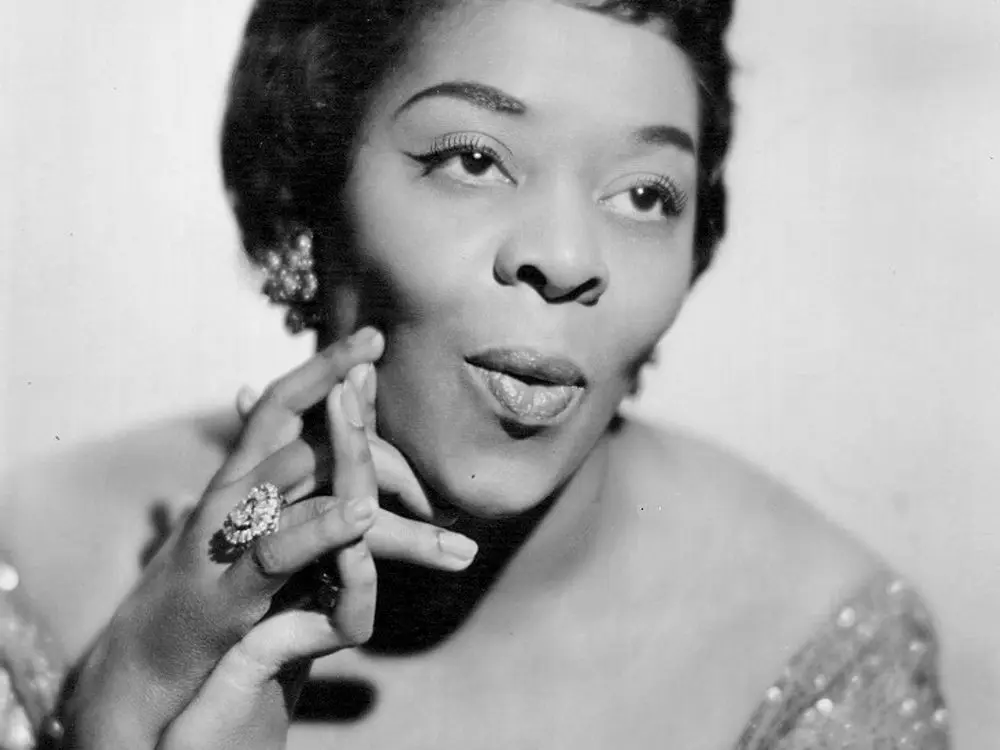
Dinah Washington
Jazz / R&B

Dinah Washington was one of the era’s most influential interpreters, combining blues expression with jazz phrasing and the clarity of pop.
She expanded her success on the R&B charts through pop standards and jazz repertoire. In every song, she brought the emotional centre of the lyric into sharp focus.
Where did the sound come from?
Born Ruth Lee Jones in Alabama and raised in Chicago, Washington played piano and sang gospel in church before turning to secular material in clubs as a teenager. Joining Lionel Hampton’s orchestra, and making early records such as “Evil Gal Blues”, introduced her commanding blues phrasing to a national audience.
By the late 1940s, she had become one of Mercury Records’ major stars under the name Dinah Washington. She treated jazz, blues, R&B and pop standards as different expressions of one musical personality rather than as separate careers.
The years that changed the course
During the 1950s, records such as “I Wanna Be Loved” and “Teach Me Tonight” kept her a force in R&B and pop; “Baby (You’ve Got What It Takes)” extended that success into 1960. The orchestral “What a Diff’rence a Day Makes”, released in 1959, brought a major crossover breakthrough and a Grammy at the second annual awards.
In clubs, concert halls and the studio, Washington moved easily from blues to albums of standards. Some jazz critics questioned her record company’s strategy of reaching the pop audience, but that flexibility was also a natural expression of her considerable interpretive range.
What made the sound instantly recognisable?
Her voice was incisive, clear and emotionally direct. She could slide gently into a note, place an accent inside a word and reshape a melody around the rhythm of speech. Even an ordinary pop song acquired blues tension in her hands.
Washington did not need volume to be dramatic. A brief syllable could carry contempt, desire or hurt. Jazz timing and gospel directness met within the same voice.
The world behind the stage
The title Queen of the Blues is apt but incomplete. Her career shows that, even when the genre categories of the 1950s appeared rigid as marketing tools, great Black female singers often ranged much more freely through their repertoire.
Turning points
Washington moved from gospel and the Chicago club scene into Lionel Hampton’s orchestra, establishing a strong career in blues, jazz and pop during the 1940s. For Mercury in the 1950s, she recorded “I Wanna Be Loved”, “Teach Me Tonight”, “What a Diff’rence a Day Makes” and numerous blues and jazz sessions. The 1959 recording of “What a Diff’rence a Day Makes” brought widespread pop success and a Grammy at the following awards. She carried her R&B authority into mainstream orchestral pop while retaining her standing in jazz, although this versatility sometimes created tension with her label’s market strategy.
Inside the studio
Her singing combined sharp diction, a slight nasal colour and accents that made each word a dramatic focal point. She could speak a blues line, relax the beat in a jazz standard or deliver a strong pop ballad in front of strings. Work with arrangers including Quincy Jones and Belford Hendricks placed her voice in new orchestral settings. Emotion never overwhelmed control: even the most painful lyric remained firmly held in rhythm and pitch.
Who carried the influence forward?
The Queen of the Blues title need not narrow Washington’s field. It can also describe her ability to cross the artificial boundaries between blues, jazz, R&B and pop. Aretha Franklin, Nancy Wilson and many other singers were influenced by the weight she gave to words. Her career challenged the assumption that Black female vocalists had to soften their voices to reach the mainstream; even in pop arrangements, she retained her character.
A listening guide to the 1950s
This is a listening route, not a ranking of the best songs. These starting points trace the artist’s development across the decade, different sides of the music and its place in history.
I Wanna Be Loved
An early success bringing together R&B feeling and pop sensibility.
Trouble in Mind
A restrained yet deeply felt reading of a blues standard.
Teach Me Tonight
A classic example of jazz and pop phrasing.
A Rockin’ Good Way — with Brook Benton
Duet chemistry and R&B humour, carrying her 1950s achievements into 1960.
What a Diff’rence a Day Makes
An unmistakable vocal personality within orchestral pop.
The legacy in music history
Her voice dissolved the boundaries between jazz, blues and pop.
Dinah Washington’s musical identity took shape in the 1950s and continued to resonate in later decades through fresh interpretations of the repertoire, echoes of the stage approach and direct influence on other musicians. In this dossier, Oldies Radyo considers the artist as a creative force in the evolution of popular music, alongside the nostalgic appeal.
- Rock & Roll Hall of Fame – Dinah Washington
- National Endowment for the Arts – Dinah Washington
- Library of Congress – Dinah Washington search
These articles were originally written in Turkish for Oldies Radyo through comparisons of international institutional sources and archives. This English edition preserves their scope and editorial approach.
Related 1950s artist features