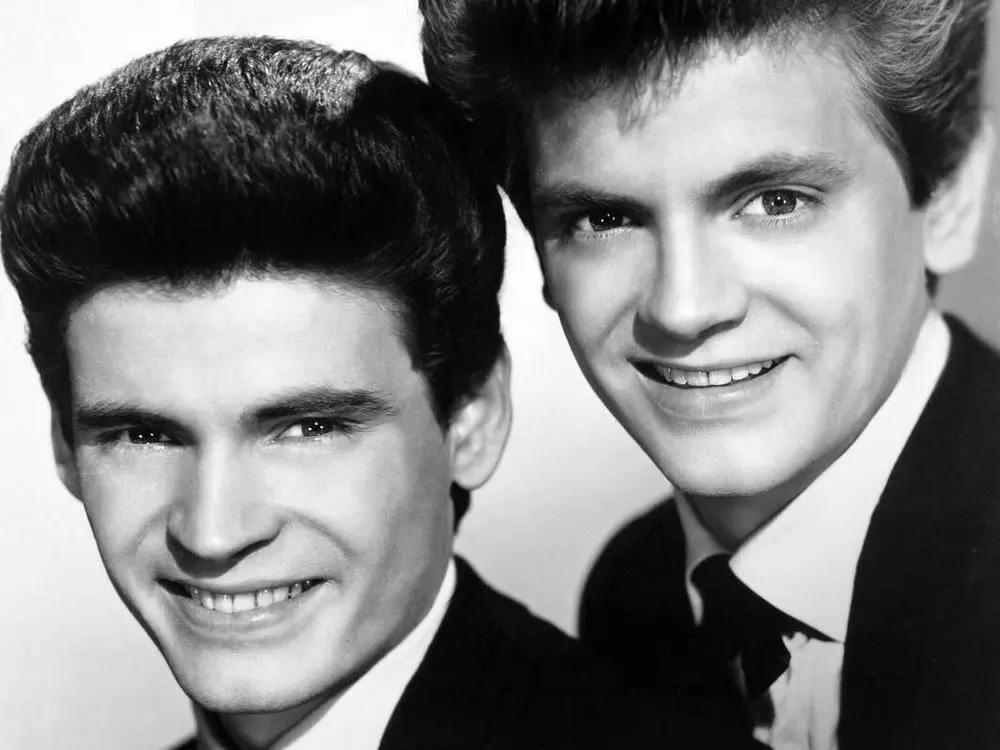
The Everly Brothers
Country / Rock ’n’ Roll

Don and Phil Everly’s close two-part harmonies joined country tradition to rock ’n’ roll’s youthful sensibility. Their melodic songs made a powerful impression on the pop charts and on the memory of later generations.
Spare, guitar-led arrangements and sibling harmonies influenced artists from the Beatles to Simon & Garfunkel. Emotional but restrained performances provided one of the fundamental models for the rock ballad.
Where did the sound come from?
Born into a musical family, Don and Phil began singing together as children on the family’s radio programme in Iowa. Their father Ike Everly’s country guitar and the family’s harmonies laid the foundation of their sound. Working with songwriters Boudleaux and Felice Bryant after arriving in Nashville changed the direction of their career.
The first recordings for Columbia brought no breakthrough. With support from Cadence Records owner Archie Bleyer, the “Bye Bye Love” they recorded in 1957 became their major success.
The years that changed the course
“Wake Up Little Susie,” “All I Have to Do Is Dream,” “Bird Dog,” “Devoted to You” and “(’Til) I Kissed You” placed them simultaneously on pop, country and R&B charts late in the 1950s. The Bryants’ songs told short, vivid stories of young love, jealousy and parental pressure.
Don’s lower lead melody and Phil’s upper harmony sounded like one doubled voice rather than two separate singers. The technique carried the Appalachian sibling-duet tradition into modern pop radio.
What made the sound instantly recognisable?
The rhythmic structure of acoustic guitars, clean arrangements by Nashville musicians and close harmonies are central to the Everly sound. They found a natural balance between rock ’n’ roll tempo and country melody.
Their vocal approach directly influenced the Beatles, Beach Boys, Simon & Garfunkel, Hollies and many country-rock artists.
The world behind the stage
The Everly Brothers showed that rock ’n’ roll was more than a hard beat: harmony, melody and emotional detail could stand at the centre of youth music, too.
Turning points
Don and Phil developed their close harmonies by singing on the family radio show from childhood. In Nashville, Chet Atkins’s support and the songs of Boudleaux and Felice Bryant shaped their career. “Bye Bye Love,” “Wake Up Little Susie,” “All I Have to Do Is Dream” and “Bird Dog” brought them to the centre of country and pop charts in 1957–1958. The Cadence years established a strong identity through spare guitars and teenage stories. Turning towards their own writing and broader studio ambitions late in the 1950s prepared them for the Warner Bros. period of the 1960s.
Inside the studio
Everly harmony draws on Appalachian and country sibling duets, but electric guitar, backbeat and compact pop forms adapted the tradition for a new generation. With Don generally carrying the lower melody and Phil the upper part, the voices move so closely that they seem like a single, expanded voice. Chet Atkins’s guitar contributions and the Nashville A-Team’s measured playing left space for the singing. On “All I Have to Do Is Dream,” tremolo guitar and a slow tempo established an enduring model for the teenage pop ballad.
Who carried the influence forward?
The Beatles, Beach Boys, Simon & Garfunkel, Hollies and Byrds took the Everly Brothers’ two-part structure as a direct model. The influence lies in their ability to make modern youth pop without concealing country roots as well as in the harmonies. Although tensions between the brothers later complicated their stage lives, the 1950s records convey complete unity. That contrast shows how pop can turn personal relationships into both a creative force and a source of pressure.
A listening guide to the 1950s
This is a listening guide rather than a greatest-hits ranking, with starting points chosen to trace the artists’ development, range and place in music history across the decade.
Bye Bye Love
Country harmony enters the mainstream with a rock ’n’ roll rhythm.
Wake Up Little Susie
Teenage innocence and social gossip handled with humour.
All I Have to Do Is Dream
One of the finest examples of two-part pop harmony.
Bird Dog
Humour and rhythmic guitar reveal their livelier side.
Devoted to You
The power of vocal intimacy within a spare arrangement.
The legacy in music history
They brought country harmony to the heart of modern pop and rock singing.
The identity the Everly Brothers established in the 1950s lived on through later reinterpretations of their repertoire, imitations of their stage approach and direct influences on musicians. Oldies Radyo approaches them here as creative participants in the transformation of popular music, as well as familiar figures from its past.
- Rock & Roll Hall of Fame – The Everly Brothers
- Country Music Hall of Fame – Everly Brothers
- Songwriters Hall of Fame – Felice and Boudleaux Bryant
The original Oldies Radyo feature was researched and written by comparing international institutional sources and archives. This English translation retains its source references.