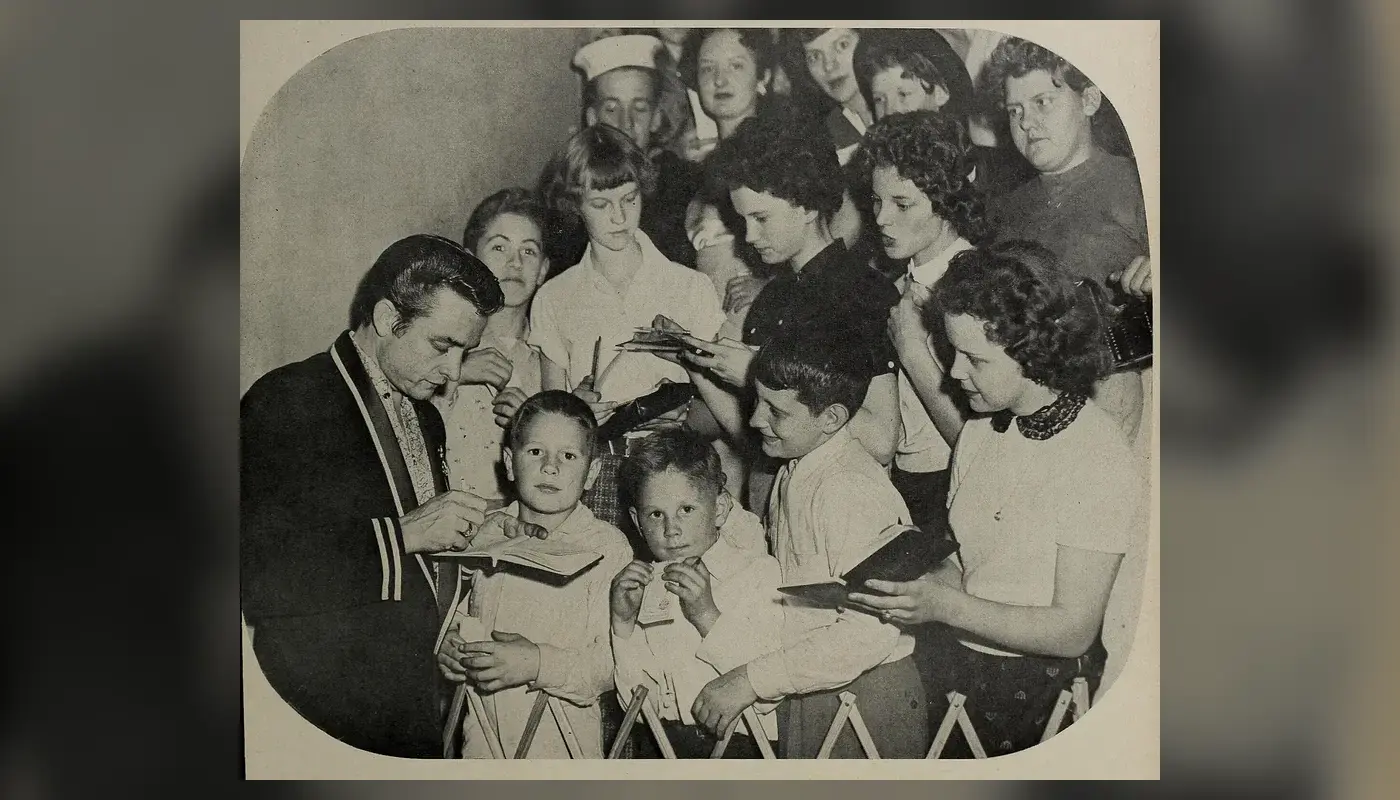
Johnny Cash
Country / Rockabilly

Johnny Cash’s deep voice, spare “boom-chicka-boom” rhythm and themes of crime, faith and travel made him one of the most distinctive artists of the Sun Records period.
“Folsom Prison Blues” and “I Walk the Line” joined country storytelling to rockabilly economy. Cash built a world of characters broader and more enduring than a teenage fashion.
Where did the sound come from?
J.R. Cash grew up in the farming colony of Dyess, Arkansas. Family work, gospel hymns, trains and his older brother’s early death left lasting marks on his songs. While serving in the Air Force in Germany, he played guitar and formed his first band.
Returning to Memphis, he formed the Tennessee Two with Luther Perkins and Marshall Grant. Sam Phillips asked for more original, commercial material instead of gospel recordings. Sun released “Hey Porter” and “Cry! Cry! Cry!” in 1955.
The years that changed the course
“Folsom Prison Blues,” “I Walk the Line,” “Home of the Blues,” “Ballad of a Teenage Queen” and “Guess Things Happen That Way” made Cash a major country-chart star. “I Walk the Line” also crossed onto the pop chart, proving that his unusual sound could reach a wide audience.
His move to Columbia in 1958 was connected to a desire for broader gospel and concept-album projects. Although the Sun period was brief, it established his central characters and rhythm.
Johnny Cash: a changing stage personality
Every image in this gallery shows Johnny Cash himself. Pictures from different periods are placed together to illustrate changes in his career.

What made the sound instantly recognisable?
Luther Perkins’s muted guitar, Marshall Grant’s bass and Cash’s acoustic rhythm create the spare walking pattern known as “boom-chicka-boom.” Even without drums, the groove moves like a locomotive.
Cash’s baritone carries weight and witness rather than heroics. Prisoners, workers, outsiders, faith and crime build an expansive American story beyond youth music.
The world behind the stage
He rose around rockabilly but did not confine his identity to one genre. Country, folk, gospel and narrative ballads came together in a modern language of records and performance.
Turning points
Cash grew up with Arkansas cotton fields, family hymns and country-gospel music on the radio. After Air Force service, the Tennessee Two he formed in Memphis with Luther Perkins and Marshall Grant auditioned for Sun with gospel material; Sam Phillips wanted something more commercial. “Cry! Cry! Cry!,” “Folsom Prison Blues,” “I Walk the Line” and “Home of the Blues” made him one of the decade’s great country stars. Sun’s focus on Elvis and Jerry Lee Lewis in the pop market helped push him towards Columbia, where he found broader space for albums and concept repertoire after 1958.
Inside the studio
The Tennessee Two’s “boom-chicka-boom” was extremely economical. Perkins’s muted electric guitar moves like train wheels, Grant anchors the bass line and Cash’s baritone brings the story forward. Absent or limited drums on the early records turn space into rhythmic tension. Prison, trains, sin, fidelity and working life fill his lyrics. The key changes and humming to find his pitch in “I Walk the Line” reveal the technical thinking behind apparently simple music.
Who carried the influence forward?
Cash opened country’s boundaries to folk, gospel, rockabilly and narrative songs. Although the black clothes and “Man in Black” identity became more pronounced later, even in the 1950s he was a storyteller wary of authority and sympathetic to criminals and outsiders. His spare moral tension helps explain the embrace of listeners from Bob Dylan to the punk generation. The Sun records are a lesson in creating a forceful personality with minimal instrumentation.
A listening guide to the 1950s
This is a listening guide rather than a greatest-hits ranking, with starting points chosen to trace the artist’s development, range and place in music history across the decade.
Cry! Cry! Cry!
His first major Sun success.
Folsom Prison Blues
Train rhythm meets crime and a longing for freedom.
I Walk the Line
An unusual combination of rhythm, key changes and a vow of fidelity.
Home of the Blues
Cash’s dark account of the city and loneliness.
Guess Things Happen That Way
Pop crossover success within a minimal arrangement.
The legacy in music history
He joined country’s storytelling power to the spare rhythm of the rock age.
The identity Johnny Cash established in the 1950s lived on through later reinterpretations of his repertoire, imitations of his stage approach and direct influences on musicians. Oldies Radyo approaches him here as a creative participant in the transformation of popular music, as well as a familiar figure from its past.
- Rock & Roll Hall of Fame – Johnny Cash
- Country Music Hall of Fame – Johnny Cash
- Johnny Cash official website
The original Oldies Radyo feature was researched and written by comparing international institutional sources and archives. This English translation retains its source references.